

Canonical
14 October 2025
NVIDIA DGX Spark: The developer’s personal AI supercomputer built on an Ubuntu base
The history of computing is a story of incredible change, but not every revolution happens at the same speed. It took decades to downsize the mainframe, invent the microprocessor, and bring computing into personal devices. Today, we are witnessing a new era: the move from massive, centralized AI clusters to powerful, on-device AI PCs. And it’s happening at an explosive pace. This article explores why the second revolution is so much faster, and how years of advancements in the Ubuntu ecosystem have helped facilitate this shift.
NVIDIA DGX Spark: huge AI models running locally
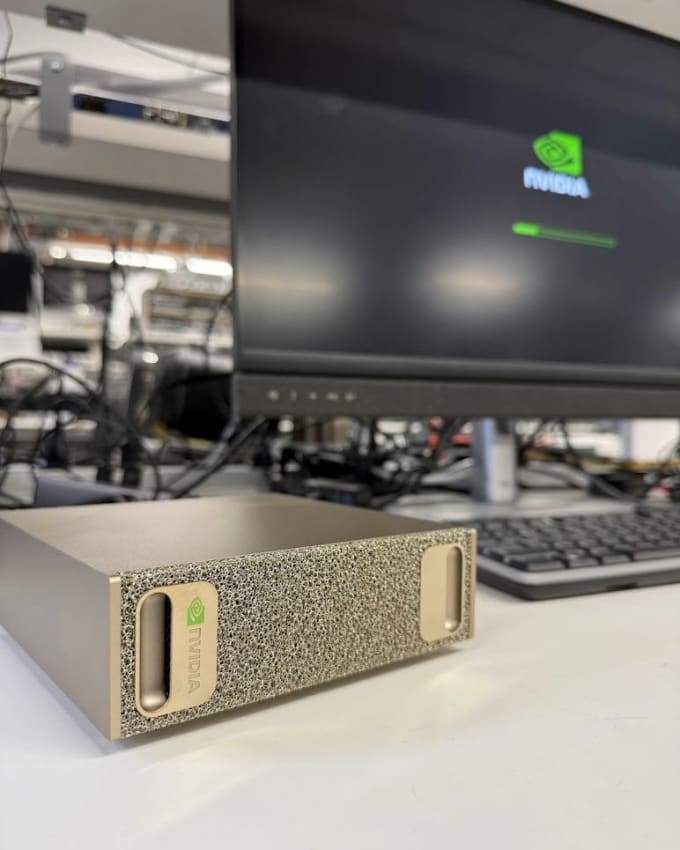
As consumers demand more AI capabilities at their fingertips, a move from massive, centralized GPU clusters to on-device AI is currently happening, at a fast pace. NVIDIA has just announced the availability of DGX Spark for AI developers. The system is designed from the ground up to build and run AI.
NVIDIA DGX Spark brings enormous computing power to the hands of developers. It delivers 1 petaFLOP of AI performance in a power-efficient, compact design. With 128 GB of unified system memory, the Blackwell GPU and the Grace CPU with 20 ARM cores, it can handle AI models of up to 200B parameters. Using NVIDIA ConnectX networking, two DGX Spark systems can be connected to work on even larger models up to 405B parameters. This setup provides a robust platform for prototyping, fine-tuning, and inferencing large models locally DGX Spark provides a full stack solution for AI developers including the NVIDIA AI software stack to accelerate AI workloads and support an incredible third-party developer ecosystem.
Ubuntu as a base for DGX OS
The NVIDIA DGX Spark operating system, DGX OS, is based on Ubuntu. DGX OS makes use of Ubuntu’s established ecosystem and trusted repositories to accelerate development. The Ubuntu ecosystem brings years of open-source maturity in the software stack, especially the software stack around the CUDA runtime and CUDA development tools. Canonical helps ensure a secure computing environment by maintaining consistent updates, patching thousands of open-source packages and addressing CVEs in a timely manner.
Ubuntu brings three fundamental pillars to enrich the developer experience in the DGX OS:
1. Ubuntu uses the same kernel for Ubuntu Server and Ubuntu Desktop
Because Ubuntu Server and Ubuntu Desktop share the same core kernel, they are not separate operating systems. This unified foundation allows developers to install server packages on the desktop and vice-versa. As a result, Ubuntu desktop benefits from years of mature development in the CUDA ecosystem on Ubuntu servers. AI workloads running on massive cloud clusters can use the exact same software stack on DGX OS, creating a consistent and stable development environment.
2. Arm support in Ubuntu
Canonical has supported Arm processors since 2011, establishing Ubuntu as a scalable platform for AI on both servers and devices. This long-standing and consistent support for the 64-bit Armv8 architecture ensures NVIDIA DGX Spark, which features an ARM-based Grace CPU, is fully supported from its launch.
3. Mature package distribution and supply chain security
DGX OS leverages Ubuntu’s mature package management and resilient software supply chain to be a production-ready platform. It inherits trusted repositories, ensuring software is validated. Additionally, Canonical’s Expanded Security Maintenance (ESM), available through Ubuntu Pro, provides timely security patches for open source packages, which are critical for AI and data science workloads.
By building DGX OS on Ubuntu, NVIDIA could leverage the same software that runs on cloud servers for a compact desktop device. This was possible due to Ubuntu’s mature support for Arm processors and its securely-designed software supply chain, which created a stable, production-ready platform and significantly sped up development.
A unified developer experience
The NVIDIA AI platform software architecture makes it possible for DGX Spark users to easily move their models from their desktop to DGX Cloud or any accelerated cloud or data center infrastructure, making it easier to prototype, fine-tune, and iterate.
To give developers a familiar experience, NVIDIA DGX Spark mirrors the same software architecture that powers industrial-strength AI factories. It comes preconfigured with the latest NVIDIA AI software stack, along with developer program access to NVIDIA NIM™ and NVIDIA Blueprints. This means developers can hit the ground running using leading open source AI models and common tools such as PyTorch, Jupyter, and Ollama to prototype, fine-tune, and inference on NVIDIA DGX Spark and easily deploy in the data center or cloud. With DGX Spark, developers benefit from a familiar environment and a streamlined setup experience via a setup wizard that ensures fast onboarding.
Looking ahead
The introduction of NVIDIA DGX Spark marks an exciting milestone in desktop AI computing. As AI continues to transform industries and drive innovation, tools like DGX Spark will play a crucial role in democratizing access to powerful AI development resources. At Canonical, we’re excited to continue our collaboration with NVIDIA, supporting the AI community with robust, open-source solutions that power the next generation of AI breakthroughs.
Learn more about Canonical’s work with NVIDIA


